


The key to maintaining full occupancy through the shoulder season lies in viewing professional grade patio heaters as a strategic revenue generator rather than a simple utility expense.
At Lux Yard and Homes, we have observed that the most successful restaurateurs treat their outdoor climate control as an essential part of their infrastructure. By implementing high performance heating solutions with a calculated heat radius, you can effectively eliminate the temperature barriers that prevent guests from enjoying your outdoor space, ensuring that every seat remains a profit center regardless of the forecast.
When the mercury begins to drop, many establishments suffer from the "Dead Zone" effect where patio revenue simply vanishes. This is a high stakes operational problem for any hospitality business.
If forty percent of your total seating is outdoors and it is too cold for guests to remain comfortable, your restaurant is forced to operate at a sixty percent capacity during your most critical peak hours. This lost revenue is rarely recovered and it represents a significant drain on your seasonal margins.
The goal of this guide is to provide you with the expert insight needed to navigate these specific challenges. We will break down the essential metrics for your restaurant including how to calculate heat coverage, maintain guest safety, and maximize fuel efficiency. By understanding how to properly choose and place your patio heaters to increase table turnover, you can transform your patio into a year round destination that protects your bottom line.
Table of Contents
What is the Ideal Heat Radius for Commercial Patio Heaters?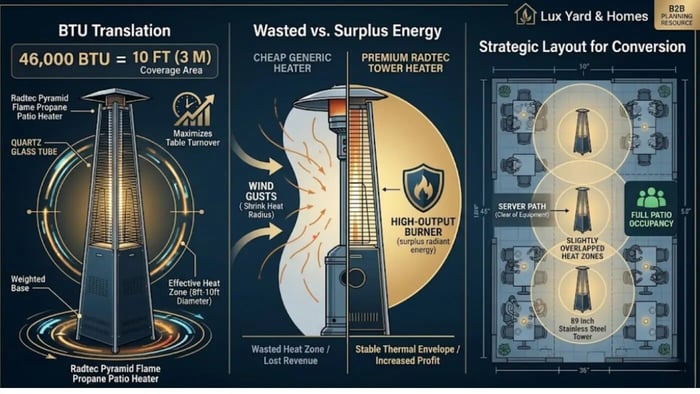
Understanding the technical relationship between thermal output and physical coverage is the first step toward reclaiming your outdoor seating revenue. In a professional setting, we rely on the British Thermal Unit or BTU to measure the heat a unit can produce.
For most commercial applications, the Radtec standard of 40000 to 60000 BTUs is the benchmark for high performance patio heaters. While these numbers look impressive on a specification sheet, their true value lies in how they translate to real world floor space. Effectively, a single high performance unit is designed to blanket a specific area in a consistent layer of warmth, ensuring that the ambient temperature remains inviting even as the evening air cools.
The effective heat zone is the most critical metric for increasing table turnover. This is the primary radius, typically spanning an eight to ten foot diameter, where diners experience the level of comfort required to extend their stay for appetizers, desserts, or a second round of drinks.
When a guest feels the steady radiance of a unit like the Radtec Tower Flame Propane Patio Heater, they are no longer rushing to finish their meal to escape the cold. Instead, the patio becomes a viable extension of your indoor dining room, allowing you to turn tables at the same rate you would during a warm summer evening.
However, heat radius is not a static measurement because environmental variables play a significant role in thermal retention. On a commercial patio, wind speed and ambient temperature can act as invisible forces that shrink your effective heat zone. A sudden gust of wind can strip away the warm air pocket, forcing your equipment to work harder to maintain comfort.
To compensate for these factors, we recommend selecting patio heaters with high output burners that can provide a surplus of radiant energy. This ensures that even when the wind picks up, the core of your seating area remains protected within a stable thermal envelope.
Proper placement is the final variable in the equation of warmth. Balancing table density with the placement of your patio heaters is a delicate task that requires avoiding cold spots while maintaining clear server paths. If units are placed too far apart, you create pockets of discomfort that lead to guest complaints and abandoned tables. To solve this logistical challenge, we suggest mapping your patio footprint to ensure that heat radii overlap slightly.
Utilizing a strategic mix of portable units, such as the Radtec 89 Inch Stainless Steel Tower, allows you to adjust your layout based on daily reservation numbers. By calculating the exact number of units needed for your specific square footage, you can ensure that every guest has a premium experience that protects your bottom line.
Step 1: Assessing Your Outdoor Patio Layout (The Footprint Factor)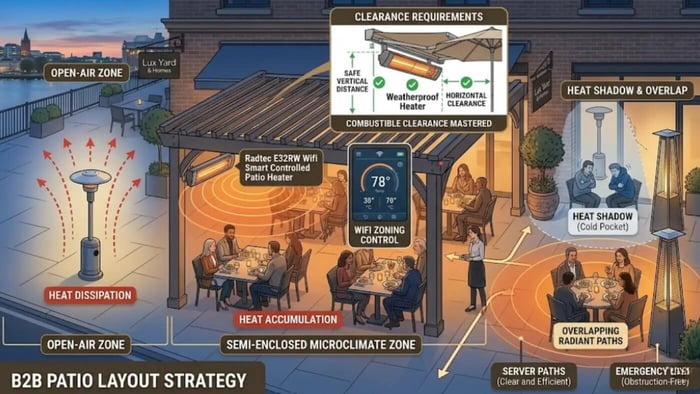
Determining the ideal placement for your outdoor patio heater requires a deep understanding of how air moves through your specific dining environment. In an open air sidewalk or plaza setting, heat tends to dissipate rapidly as there are no boundaries to trap the rising warm air. Conversely, a semi enclosed patio or a space nestled under a pergola offers a significant advantage by creating a microclimate where radiant energy can accumulate.
When working with covered areas, products such as the Radtec E32RW Wifi Smart Controlled Patio Heater are exceptional because they allow you to manage temperatures across different zones of your layout from a single interface, ensuring that the environment remains consistent as the evening progresses.
Clearance requirements are perhaps the most vital operational detail to master before finalizing your purchase of patio heaters. A common mistake in the hospitality industry is selecting powerful units without accounting for the vertical and horizontal space needed to operate safely near awnings, umbrellas, or architectural features.
Adhering to the manufacturer safety specifications protects your infrastructure and ensures compliance with local fire codes. For establishments with restricted overhead space or permanent fabric coverings, a strategic solution is the Radtec 56 Inch Weatherproof Electric Patio Heater. This unit provides high wattage performance while being mounted in a fixed position, allowing you to maintain safe distances from combustibles while still delivering intense warmth to the tables below.
The final element of a successful layout is accounting for the heat shadow. Much like light, radiant heat travels in a straight line and can be blocked by solid objects such as large planters, decorative partitions, or even the guests themselves. If you place a heater directly behind a large pillar, the guests on the other side will remain in a cold pocket.
To solve this, you must position your patio heaters so that the radiant paths overlap without obstructing the natural flow of your staff. By placing units like the Radtec 89 Inch Stainless Steel Tower at the periphery of seating clusters, you can warm your guests effectively while keeping server paths and emergency exits completely clear of equipment. This strategic positioning ensures that your patio remains both a comfortable sanctuary for diners and a safe, efficient workspace for your team.
Step 2: Choosing the Fuel Source (Operational Logistics)
Selecting the appropriate fuel source is a foundational decision that dictates both the daily overhead and the long term flexibility of your outdoor dining operation. Each energy type offers distinct advantages depending on whether you prioritize mobility, low operating costs, or climate controlled precision. Making the right choice ensures that your outdoor patio heater integrates seamlessly into your workflow rather than becoming a logistical burden for your staff.
Propane is often considered the flexible standard for the hospitality industry due to its immediate portability and lack of installation costs. This fuel source is ideal for establishments that need to move equipment to accommodate private events or changing floor plans.
However, propane requires a commitment to tank management logistics. To avoid the headache of running out of fuel mid service, many restaurateurs choose high capacity units like the Radtec 96 Inch Real Flame Propane Patio Heater. This model provides an impressive 40000 BTU output, and while it requires regular tank swaps, its independence from a gas line offers the freedom to place warmth exactly where it is needed most.
For a more permanent and cost effective solution, natural gas is the superior choice for high volume restaurants. While this option requires upfront investment in plumbing and fixed placement, the long term savings are substantial as natural gas is typically the most affordable fuel source per hour of operation.
A strategic solution for permanent installations is the Radtec 96 Inch Real Flame Natural Gas Heater. By utilizing a direct line connection, you eliminate the labor costs associated with tank management and ensure that your patio is always ready for guests with the simple turn of a valve.
Electric heating has emerged as the premier choice for precise and silent climate control, particularly in semi enclosed patios or balconies where ventilation may be a concern. Because electric units produce zero emissions, they are safe for use under permanent roof structures and awnings.
The Radtec 34 Inch Torrid Series Electric Patio Heater is an excellent example of this technology, offering intense infrared warmth without the noise or orange glow associated with other patio heaters. While these units require high voltage electrical work to install, the trade off is a low maintenance, high efficiency system that can be controlled with surgical precision to keep your guests comfortable all night long.
|
96" RADtec Real Flame Propane Patio Heater 40k BTU 
$765.00 RADtec's Real Flame Propane Patio Heater will provide sufficient warmth in your outdoor living space This elegant 8-foot tall heater emits a mesmerizing glow, adding a touch of sophistication to any outdoor space. Enjoy cozy evenings under the stars with… read more |
96" RADtec Real Flame Natural Gas Patio Heater 40k BTU 
$765.00 Transform Your Backyard into a Cozy Retreat with RADtec's Real Flame Stainless Steel Natural Gas Patio Heater Craving a relaxing escape without leaving home? Your backyard awaits! But chilly evenings can quickly put a damper on your outdoor enjoyment. That's… read more |
RADtec 34" Torrid Series Electric Patio Heater 30-TOR-INF-HT 
$890.00 Experience the warmth of the sun with RADtec's best-selling Infrared Electric Patio Heater. Available in 34", 50", 52", and 75 Stay warm and cozy on your patio even on the chilliest evenings with the powerful RADtec Torrid Series Electric Heater… read more |
Step 3: Selecting the Outdoor Patio Heater Style (Form vs. Function)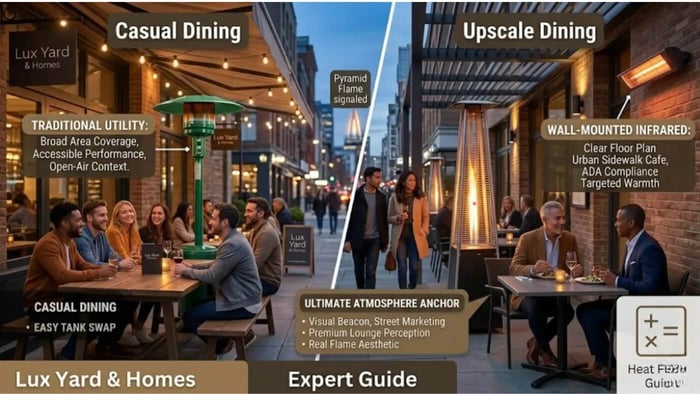
The visual profile of your heating equipment plays a significant role in how potential guests perceive your establishment from the street. Selecting a style is not merely an aesthetic choice but a marketing decision that communicates the level of comfort and luxury a diner can expect.
Mushroom style patio heaters remain the traditional utility choice for many casual dining environments because they provide broad area coverage and reliable performance at an accessible price point. These units are highly effective for warming large groups in open air settings where the primary goal is functional heat distribution.
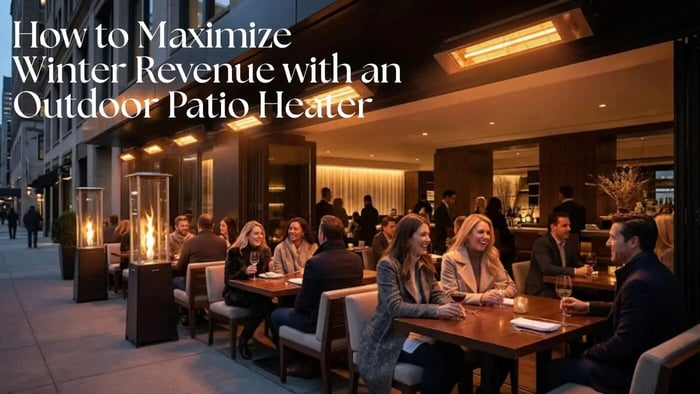
For many upscale restaurants, however, the pyramid glass tube heaters serve as the ultimate atmosphere anchor. These units act as visual beacons, signaling to pedestrians and passing traffic that your patio is open, vibrant, and warm. The business case for these models is centered on their ability to draw in foot traffic through the sheer allure of an exposed flame.
The marketing impact of the real flame aesthetic increases the perceived value of the dining experience, allowing you to position your outdoor seating as a premium lounge rather than just a secondary dining area. Models like the Radtec 93 Inch Pyramid Flame Propane Patio Heater offer this exact combination of visual drama and commercial performance.
In urban environments where sidewalk space is at a premium, wall mounted infrared patio heaters provide the best solution for maintaining a clear floor plan. By moving the heat source off the ground, you ensure that server paths remain unobstructed and maximize the number of tables you can fit in a narrow footprint.
This style of heating is particularly effective for sidewalk cafes where local ordinances may restrict the use of portable units on public walkways. Utilizing high efficiency infrared technology ensures that the warmth is directed precisely toward the guests without wasting energy on the surrounding air.
Product Deep Dive: The Radtec Pyramid Collection
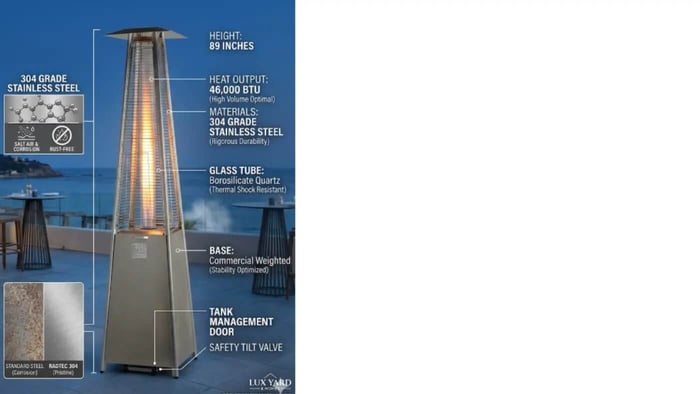
The Radtec Pyramid Collection is engineered specifically to meet the rigorous demands of the hospitality industry while offering a range of finishes to match your brand identity. For high volume urban patios and coastal dining locations, the Radtec 89 Inch Stainless Steel Tower is the premier choice. The 304 grade stainless steel construction provides superior rust resistance against salt air and heavy moisture, ensuring that your investment in patio heaters maintains its professional appearance through years of seasonal use.
For contemporary upscale bistros and designer lounges, the Radtec Matte Black Midnight series offers a sophisticated silhouette that disappears into the evening shadows.
This allows the vertical flame to become the singular focal point of your patio design. If your establishment features a more traditional or rustic aesthetic, such as a mountain tavern or a country estate, the Radtec Antique Bronze finish is specifically curated to complement natural wood and stone elements. Each of these models shares the same commercial grade specifications, including high output burners and weighted bases for maximum stability.
Safety is the cornerstone of the Radtec design philosophy, which is essential for preventing insurance liabilities in a busy restaurant environment. Every unit in the collection is equipped with a safety tilt valve that automatically cuts the gas flow if the unit is moved beyond a safe angle.
Additionally, the use of borosilicate quartz glass ensures that the heating tube can withstand freezing rain or accidental splashes without cracking while at peak temperature. These commercial safety specs provide restaurateurs with the peace of mind needed to focus on service rather than equipment monitoring.
Step 4: Solving Real World Restaurant Problems
Operational success often hinges on how well your equipment handles the unpredictable nature of a live service environment. One of the most common safety liabilities in a restaurant is the risk of guests or staff accidentally bumping into a heating unit.
Radtec solves this problem by utilizing heavily weighted bases that lower the center of gravity and built in automatic shut off sensors. These features ensure that even in a crowded environment, your heating system remains a safe and stable part of your infrastructure.
The wind factor is another significant challenge for outdoor dining, as gusts can often blow out pilot lights or cause top heavy units to tip. Radtec patio heaters are designed with high output burners that maintain a stable flame even in breezy conditions. The stable footprints of the tower and pyramid models provide the physical resilience needed to stand firm during inclement weather. This reliability ensures that your staff does not have to spend their shift relighting heaters, allowing them to remain focused on guest hospitality and table service.
Finally, aesthetic clutter can detract from the luxury experience of a high end menu. Placing cheap or mismatched patio heaters next to an expensive steak or a fine wine can lower the guest’s perception of your brand. By utilizing designer finishes like matte black or antique bronze, you can match your heating equipment to your restaurant’s specific brand identity. This creates a cohesive and immersive environment where every detail, from the furniture to the climate control, signals a commitment to quality and excellence.
Step 5: Compliance and ROI (The Closer)
Navigating fire marshal expectations and local permitting is a necessary part of establishing a permanent outdoor heating plan. Compliance typically involves maintaining specific distances from combustibles and ensuring that fuel storage meets local safety codes.
For establishments utilizing propane, understanding the rules for tank storage is vital for a smooth inspection. Additionally, ADA compliance must be considered to ensure that heater placement does not obstruct wheelchair access or create bottlenecks in your accessible dining paths.
The return on investment for professional patio heaters is calculated through the increase in table turnover and the extension of your operating season. By adding just two or three additional table turns per night during the cooler months, the equipment often pays for itself within a single season. The ability to seat your patio during a Tuesday night in October transforms your outdoor space from a liability into a high margin profit center. When you factor in the marketing value of a glowing flame, the ROI becomes even more significant for businesses looking to stand out in a competitive market.
Fuel efficiency remains a top priority for maintaining your seasonal margins. We recommend training staff on simple strategies such as only activating heaters when tables are actually seated or using smart controlled units like the Radtec E32RW Wifi Smart Controlled Patio Heater to schedule heating times. By managing your energy usage with precision, you can minimize waste while still providing a premium experience for every guest.
Making the Investment on an Outdoor Patio Heater
Ultimately, the best patio heater is not the one with the lowest price tag, but the one that keeps the most tables full throughout the year. Investing in professional grade equipment like the Radtec collection is an investment in your restaurant's capacity and its future revenue.
By prioritizing durability, safety, and a calculated heat radius, you can eliminate the dead zone of the shoulder season and ensure that your patio remains a vibrant, profitable destination.
At Lux Yard and Homes, we are committed to helping you find the precise heating solutions that solve your specific operational challenges. Whether you require the flexibility of propane or the permanence of natural gas, our team is ready to assist you in maximizing your outdoor potential. We invite you to explore the Radtec Commercial collection and request a bulk quote to begin transforming your outdoor seating into a year round profit center.
FAQs
How much does a patio heater cost?
The cost of a patio heater typically ranges from $200 to $1,500+ depending on the fuel source, durability, and heat output. For a professional restaurant setting, the investment should be viewed based on the intended ROI and table turnover potential.
Price Breakdown by Heater Style
| Heater Type | Typical Price Range | Best Use Case |
| Mushroom (Propane) | $200 – $400 | Casual dining and broad area coverage. |
| Pyramid Flame | $400 – $900 | Upscale "Atmosphere Anchors" to draw foot traffic. |
| Electric Infrared | $600 – $1,200 | Permanent, zero-emission heat for semi-enclosed patios. |
| Natural Gas | $700 – $1,500 | High-volume patios looking for the lowest operating cost. |
What is the best heater for an outdoor patio?
The best professional solution is typically a high-output radiant heater (40,000+ BTUs) that matches your operational needs. While a sidewalk café requires a different strategy than a coastal resort, the Radtec Pyramid and Tower series are currently the industry benchmarks for durability and performance.
The Best Choice by Operational Need
| Business Need | Recommended Heater Style | Top Strategic Solution |
| Street Marketing | Pyramid Flame Heaters | Radtec 93" Pyramid Flame |
| Coastal/High Moisture | 304-Grade Stainless Steel | Radtec 89" Stainless Tower |
| Small/Urban Spaces | Wall-Mounted Electric | Radtec 56" Weatherproof Electric |
| Maximum Mobility | Portable Propane Towers | Radtec 96" Real Flame Propane |
Top Criteria for Choosing the Best Unit
Heat Radius (The 10-Foot Rule): The best patio heaters provide an effective heat zone of at least an 8 to 10 foot diameter. This ensures guests stay comfortable enough to order dessert and extra rounds of drinks.
Fuel Efficiency vs. Mobility: Propane is the best for flexible floor plans and private events, while Natural Gas or Electric is the best for permanent installations where you want to eliminate tank management labor.
Safety & Liability: In a busy hospitality environment, the best units must include a Safety Tilt Valve and Borosilicate Quartz Glass to prevent accidents and insurance issues.
Aesthetic Alignment: Your heating should match your menu price point. A matte black or antique bronze finish is often the best choice for upscale bistros to maintain a luxury brand perception.
Expert Recommendation: For most high-volume restaurants, a mix of Radtec Pyramid heaters for visual appeal and Wall-Mounted Infrared units for targeted warmth provides the most reliable return on investment.
How big of an area will a 10,000 BTU propane heater heat?
A 10,000 BTU heater will typically heat a small, concentrated area of approximately 25 to 30 square feet. In a professional restaurant setting, this translates to a heat radius of only 1.5 to 2 feet from the unit, which is usually only enough to warm a single small bistro table for two.
Commercial Comparison: 10k BTU vs. Professional Standards
| Metric | 10,000 BTU (Entry/Tabletop) | 46,000 BTU (Commercial Standard) |
| Approx. Coverage | 25 – 30 Sq. Ft. | 150 – 200 Sq. Ft. |
| Effective Radius | ~2 Feet | 8 – 10 Feet |
| Capacity | 1 Small Table | 3 – 5 Tables (with overlap) |
| Best Use Case | Individual personal warmth. | High-volume table turnover. |
Why 10,000 BTUs May Fall Short for Restaurants
The Wind Factor: Because 10,000 BTUs produce a lower volume of radiant energy, a light breeze can easily strip away the heat pocket. Professional patio heaters like the Radtec Tower series utilize 40,000+ BTUs to create a stable "thermal envelope" that resists environmental variables.
Table Density: To heat a standard 20-table patio using only 10,000 BTU units, you would need a heater on every single table. This creates significant "aesthetic clutter" and doubles the labor required for tank management.
Ambient Temperature: In true "shoulder season" weather (below 55°F), a 10,000 BTU output is often insufficient to raise the ambient temperature enough for guests to stay for appetizers or dessert.
Expert Planning Tip: For commercial success, we recommend bypassing low-BTU units in favor of a Radtec 89 Inch Tower or Pyramid Flame unit. These 46,000 BTU models provide the "Effective Heat Zone" required to transform your patio into a consistent profit center.
Is it cheaper to heat with propane or electricity?
In terms of hourly operation, electricity is significantly cheaper than propane. On average, a standard electric patio heater costs approximately $0.20 to $0.60 per hour to run, whereas an equivalent propane unit averages $1.50 to $2.00 per hour due to the cost of fuel and the labor required for tank management.
Hourly Operating Cost Comparison (2026 Estimates)
| Fuel Source | Cost Per Hour | Labor Requirement | Best Use Case |
| Natural Gas | $0.25 – $0.50 | None (Fixed Line) | Permanent high-volume patios. |
| Electric (Infrared) | $0.30 – $0.70 | None (Switch/Remote) | Semi-enclosed or covered areas. |
| Propane (Tank) | $1.50 – $2.50 | High (Tank Swaps) | Flexible layouts & private events. |
The Total Cost of Ownership (TCO)
Installation Costs: Electric patio heaters often require a higher upfront investment because they usually need professional hardwiring and a dedicated 240V circuit. Propane units are "plug-and-play" with no installation fees, making them cheaper to start but more expensive to maintain.
Maintenance & Labor: Propane is the most "expensive" in terms of labor. Your staff must monitor tank levels, store backups, and swap tanks mid-service. Electric heaters like the Radtec Torrid Series are virtually maintenance-free, allowing your team to focus entirely on guest service.
Energy Efficiency: Electric infrared technology is nearly 90% efficient, as it warms objects directly rather than the air. Propane heaters (especially mushroom styles) lose significant heat to the wind, which can drive up your effective cost per guest during breezy evenings.
The Natural Gas Exception: If your building already has a gas line, Natural Gas patio heaters are the gold standard for ROI, offering the highest BTU output for the lowest possible energy bill.
Expert Insight: For a restaurant operating 5 nights a week, the fuel savings from switching from propane to electric or natural gas typically pay for the installation costs within the first two seasons.