


Finding the best heater for screened porch enclosures requires a deep understanding of thermal dynamics, local building codes, and structural safety parameters. When expanding a premium residential layout, a seasonal screened porch serves as the ultimate transitional living zone, bridging the boundary between a home's climate-controlled interior and raw outdoor elements.
However, heating these unique semi-enclosed configurations presents a major engineering challenge for custom builders and premium landscape architects. Traditional open-flame propane or natural gas units cannot be deployed safely due to strict ventilation restrictions, overhead clearance codes, and fire hazards.
If you are currently evaluating options for the best heater for screened porch environments, bypassing generic retail appliances is crucial to protecting both your estate's structural architecture and your family's safety.
This technical case study analyzes a luxury residential remodel in Lake Forest, Illinois, detailing how a design team successfully integrated flush-mounted heating hardware to transform a cold, seasonal screened terrace into a functional, year-round lounge.
Table of Contents
- The Screened Porch Dilemma: Thermal Loss vs. Safety Compliance
- What is the Best Heater for Screened Porch Enclosures?
- The Hardware Specification Matrix
- Technical Infographic: Electrical Routing & Zone Layout
- Installation Blueprint: Mounting Profiles and Electrical Routing
- Smart Home Automation and Living Space Integration
- FAQs
The Screened Porch Dilemma: Thermal Loss vs. Safety Compliance
The Lake Forest estate featured a beautifully appointed 400-square-foot screened porch complete with custom cedar tongue-and-groove ceilings, exposed timber framing, and premium floor-to-ceiling fine mesh screens.
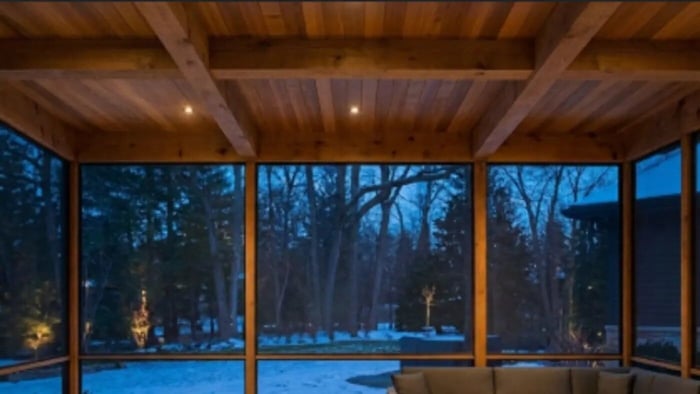
While the space offered excellent protection from insects during the summer months, the homeowner faced a massive obstacle during the late autumn and winter seasons when looking for a good outdoor heaters strategy.
The custom design team had to overcome three strict architectural parameters:
Combustion and Zero Ventilation Hazards: Because a screened porch restricts free-flowing cross-breezes compared to an open deck, standard gas or liquid propane heaters pose an immediate threat regarding carbon monoxide accumulation and oxygen depletion.
Strict Overhead Clearances: The low-slung, finished wood ceiling structure completely eliminated the possibility of utilizing a high-output, free-standing outdoor space heater, which demands massive vertical safety perimeters from combustible wood beams.
The Visual Continuity Requirement: The interior architecture featured an open-concept living room that flowed seamlessly into the porch via large sliding glass doors. Introducing a bulky, intrusive retail appliance or a standard outdoor heat lamp stand would instantly compromise the clean, minimal aesthetic.
To resolve these environmental factors, the project design team moved away from traditional convection heating and turned to premium, long-wave far-infrared electric technology.
What is the Best Heater for Screened Porch Enclosures?
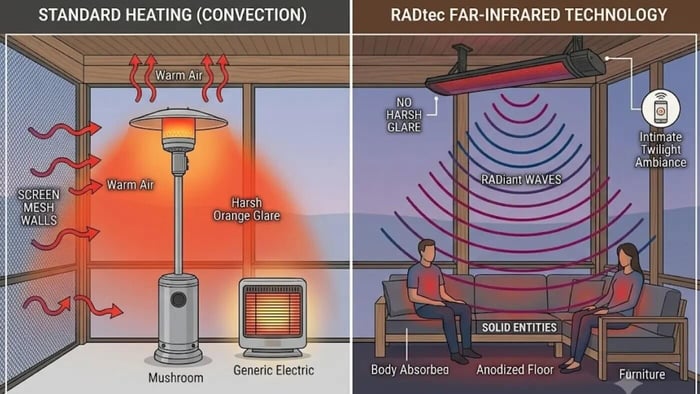
To understand why far-infrared technology is universally recognized as the best heater for screened porch environments, it is important to examine how thermal physics operates in a semi-enclosed space.
Standard outdoor heaters function via convection, which means they warm the air immediately surrounding the heating element. In a screened porch layout, convection fails completely because warm air naturally rises and escapes right through the mesh screens, resulting in astronomical utility costs and zero thermal comfort.
Far-infrared radiant technology operates on an entirely different physical principle. Instead of wasting energy warming ambient air currents, radiant waves travel silently through space and transfer thermal energy directly to solid entities, such as the floor, the furniture, and human bodies.
For this specific architectural layout, the design team specified RADtec Designer Series Zero Light Electric Patio Heaters. Because these units feature a specialized anodized alloy casing without an exposed glowing bulb, they function perfectly as an outdoor electric heater without emitting any harsh orange glare. This preserves the intimate, high-end twilight ambiance of the home while maintaining an incredible 90% thermal efficiency rating.
The Hardware Specification Matrix
To effectively implement the best heater for screened porch layout without overcrowding the ceiling plane, the spatial footprint was divided into two distinct thermal zones: a primary deep-seating lounge zone and a secondary transition corridor. The hardware configuration below highlights the exact specifications sourced directly from the curated inventory at Lux Yard and Homes.
Sourced Enclosed Space Heating Profile
| Component Detail | Primary Heating Zone Sourcing | Secondary Transition Zone Sourcing |
| Direct Product Link | RADtec 82.5" Zero Light Electric Patio Heater | RADtec 44" WiFi Smart Controlled Zero Light Patio Heater |
| Power Consumption | 3200W / 220-240V Configuration | 1500W / 110-120V Configuration |
| Element Architecture | Long-Wave Far-Infrared Zero Light Panel | Smart-Enabled Zero Light Radiant Matrix |
| Coverage Footprint | Up to 100 sq. ft. per unit (Structural Focus) | Up to 50 sq. ft. zone-specific boundary |
| Installation Profile | Permanent Flush Ceiling Bracket Mounting | Wall-Hung Pivot Angle Bracket Configuration |
| Control Framework | Discrete Multi-Stage Remote Control | Smart App Integration / Automated Scheduling |
RADtec 82.5" Zero Light Electric Patio Heater (3200W/220V)

$1,285.00
Experience Outdoor Comfort Year-Round with RADtec Designer Series ZERO LIGHT Electric Patio Heater. RADtec's stylish and efficient outdoor electric heater provides instant warmth without the glare. You can enjoy your patio, deck, or balcony even on chilly evenings. It is… read more
RADtec E32Rw WiFi Smart Controlled Patio Heater

$1,245.00
Experience the ultimate in comfort and convenience with RADtec's Infrared Radiant Patio Heater, now enhanced with WiFi Smart Control. Effortlessly manage your heating from anywhere using RADtec's user-friendly smartphone app. This innovative heater operates silently and emits no visible light… read more
Technical Infographic: Electrical Routing & Zone Layout
The infographic below maps the spatial engineering flow from the home’s main power grid out to the dual thermal zones on the screened porch terrace, illustrating how to set up the best heater for screened porch architectural systems.
                  [Main Home Breaker Panel]
                            │
         ┌──────────────────┴──────────────────┐
         ▼                                     ▼
(Dedicated 240V / 20A Circuit)       (Dedicated 120V / 15A Circuit)
         │                                     │
         ▼                                     ▼
 [Primary Lounge Zone]                [Secondary Transition Corridor]
 2x RADtec 82.5" 3200W Heaters        1x RADtec 44" 1500W Smart Heater
 (Ceiling Flush Mount at 45° Pitch)   (Wall-Hung Pivot Bracket)
Installation Blueprint: Mounting Profiles and Electrical Routing
Executing a clean, code-compliant installation requires precise electrical infrastructure planning. Unlike simple plug-and-play good outdoor heaters, high-output electric radiant panels require dedicated line voltage to serve as the best heater for screened porch permanent installations.
The Electrical Infrastructure
The primary lounge zone utilized two RADtec 82.5" 3200W Heaters. Because these high-capacity units require a stable 220-240V circuit, the contractor pulled dedicated 20-amp dual-pole breakers directly from the home's main distribution panel. For the smaller transition zone, the RADtec 44" 1500W Smart Unit was safely wired to a standard 110-120V circuit, making it a highly versatile outdoor space heater option for structural integration.
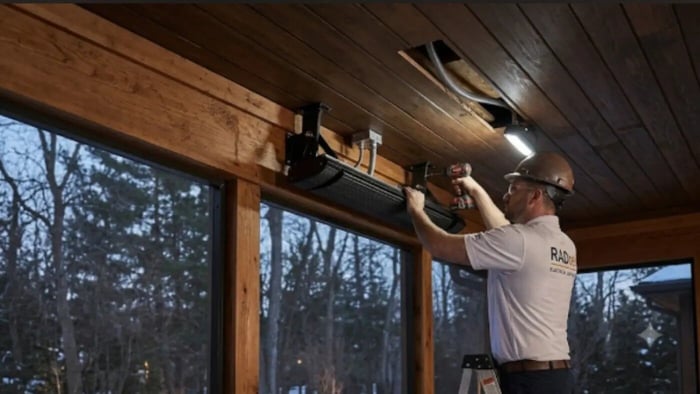
Strategic Placement and Angular Physics
To maximize the radiant footprint of your outdoor heaters, the two large RADtec panels were mounted directly overhead into the ceiling structure at a height of 8.5 feet, angled inward at a precise 45-degree pitch. This configuration creates an overlapping "thermal blanket" across the central sectional sofa.
Because the RADtec Zero Light series features an impressive IPX5 weatherproof rating, the internal heating components remain completely protected against horizontal rain or melting snow drifting through the porch screens. The minimalist, matte-black profile of the heaters allowed them to blend directly into the dark timber ceiling architecture, rendering them virtually invisible until turned on.
Smart Home Automation and Living Space Integration
Beyond safe thermal output and visual continuity, the Lake Forest project demanded modern convenience. By utilizing the RADtec WiFi Smart Controlled series as their choice for the best heater for screened porch functionality, the homeowner completely eliminated the need for manual wall switches or tracking down an outdoor heat lamp remote.
The integrated smart module connects directly to the local home automation network. This allows the homeowner to access the custom heating profiles directly via smartphone or voice command. The system can be programmed to pre-heat the screened porch seating area automatically 15 minutes before scheduled use, adjusting the power output dynamically based on external ambient temperature shifts.
When searching for the absolute best heater for screened porch layouts, this level of seamless technology integration is what elevates a project from a basic seasonal room to an elite, multi-season architectural masterpiece.
FAQs
Is it safe to run an outdoor electric heater under a covered or screened porch wood ceiling?
Yes, provided you use certified electric radiant hardware like the RADtec Zero Light series and adhere to strict mounting clearances. Because these units convert electrical energy into far-infrared waves rather than utilizing open combustion, there are no live flames or carbon monoxide hazards. Always maintain the manufacturer-specified clearance distance—typically a minimum of 6 to 12 inches from the top of the heater to a combustible wood ceiling—using the included mounting brackets to ensure it functions safely as the best heater for screened porch use.
Can I use a liquid propane or natural gas outdoor space heater inside a screened porch?
No, it is highly unsafe to operate standard gas or propane patio heaters inside any screened or semi-enclosed porch. Gas heaters require massive amounts of open-air ventilation to safely disperse toxic combustion byproducts like carbon monoxide. Furthermore, their high vertical clearance requirements (often 3 to 4 feet of open space above the burner) present a severe fire hazard when placed under wood ceilings, eaves, or canvas awnings, meaning an electric unit is always the best heater for screened porch layouts.
What is the difference between a "Zero Light" infrared heater and a standard outdoor heat lamp?
Standard outdoor heat lamp fixtures use short-wave quartz or halogen bulbs that emit a very bright, intense orange or red glow. While effective, this glare can be highly distracting and compromise the evening ambiance of a luxury outdoor living area. Zero Light infrared heaters utilize an advanced, completely insulated anodized heating element that transfers heat to the front panel, emitting comforting warmth across the space without producing any visible light, making them the premier good outdoor heaters choice for upscale properties.
How do I choose between a 110V and a 240V outdoor electric heater for my porch?
The choice depends entirely on your total square footage and available electrical infrastructure. A 110-120V heater (like the RADtec 44" 1500W panel) is highly convenient, draws less power, and can often run on standard household circuits for spot-heating smaller areas. However, to heat larger spaces or combat cold winter climates, the best heater for screened porch configurations will require the high-output thermal capacity of a 220-240V unit (like the RADtec 82.5" 3200W panel), which requires a dedicated circuit installed by a licensed electrician.
Will wind or cold drafts blowing through the screens ruin the performance of my outdoor heaters?
Traditional convection heaters that warm the air will fail completely in a screened porch because drafts blow the warm air right through the screens. However, because RADtec’s far-infrared heaters directly warm solid objects rather than the surrounding air, the thermal comfort remains highly effective even when a brisk seasonal breeze passes directly through the porch mesh, cementing its position as the best heater for screened porch applications.