

When estate owners along Grand Traverse Bay upgrade to an elite open air kitchen footprint, they frequently run into a frustrating regional limitation: single cooking surface friction. Traditional open grill grates are spectacular for radiant, high heat protein charring, but they fail completely when attempting to execute delicate, high contact culinary techniques. Searing fresh caught Lake Michigan whitefish, pressing smash burgers, or griddled morning diner breakfasts overlooking the water all require a flat surface.
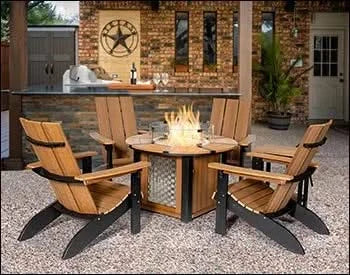
To overcome this spatial and thermal hurdle, a luxury homeowner in the Traverse City, MI 49684 area integrated our commercial grade two sided cast iron griddle directly into their centerpiece ibbq Angara social grill table setup.
This product case study breaks down the material physics and hardware compatibility required to convert a luxury social grill into an all in one, multi zone culinary powerhouse capable of handling Northern Michigan’s shifting maritime micro climates without altering the signature design layout of the table.
Table of Contents
- The Material Physics of High-Ticket Cookware
- Why Choose a Two-Sided Cast Iron Griddle for Luxury Outdoor Kitchens?
- Side-A Case Study Analysis (The Flawless Conduction Crust)
- Side B Case Study Analysis (The Engineered Radiant Ridge)
- Northern Michigan Climate & Maintenance Realities
- Direct Structural Alignment: Final Architectural Review
- FAQs
The Material Physics of High-Ticket Cookware
Outdoor cooking in the Great Lakes region is not just about high BTUs. It is entirely about thermal retention, wind resistance, and inertial mass. Standard mass market retail griddle attachments are typically stamped from thin rolled steel or lightweight aluminum.
Under intense direct gas flames, especially when exposed to chilly evening gusts rolling off the West Arm of the bay, these thin metals suffer from rapid thermal deflection. They warp out of shape, lose heat instantly, and create massive, unpredictable cool spots across the cooking footprint.
When you transition to an authentic, heavy duty two sided cast iron griddle, you are deploying a dense molecular structure that acts as a true thermal battery. The heavy gauge iron absorbs raw heat from the burners and locks it in, making it completely immune to sudden drop offs in ambient lakeside temperatures.
As an authorized dealer of these premium engineering components, our product sourcing tests confirm that whether you drop a cold wagyu patty on the far left or the dead center of the plate, the surface temperature maintains its searing equilibrium. This guarantees a perfect, continuous Maillard reaction every single time.
[ Thin Stamped Steel + Bay Winds ] ---> Rapid Heat Loss & Warping ---> Uneven Searing
[ Heavy Inertial Cast Iron ]         ---> Absorbs & Locks Heat    ---> Uniform Thermal Equilibrium
Why Choose a Two-Sided Cast Iron Griddle for Luxury Outdoor Kitchens?
The Architecture of Dual-Utility Footprints
Most high end patio designs in Traverse City have a strict spatial budget, especially when working within covered timber frame porches designed to shield entertaining spaces from sudden Michigan rain showers. Forcing a separate, standalone flat top flat iron appliance alongside a traditional gas grill clutters the visual aesthetic and requires running secondary, independent gas lines through expensive hardscaping.
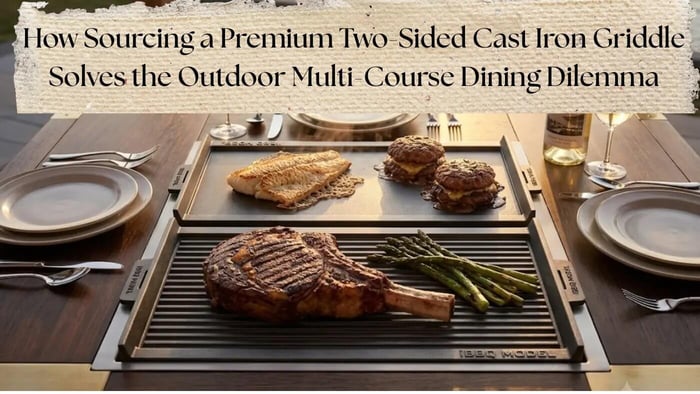
The implementation of a premium, reversible two sided cast iron griddle completely bypasses this hardware redundancy by offering two distinct, high performance cooking environments on a single, heavy gauge plate.
| Cooking Surface Vector | Engineered Micro-Environment | Elite Menu Application | Thermal Performance Advantage |
| Side A: Ultra-Smooth Flat Top | High-contact continuous surface | Smash burgers, delicate whitefish fillets, cherry-infused morning crepes | Total surface conduction maximizing caramelized crusts |
| Side B: Deep-Grooved Steakhouse Grates | High-profile elevated radiant ridges | Filet mignon, thick-cut ribeyes, charred local asparagus | Sharp sear-line articulation while channeling excess rendering away |
Two Sided Cast Iron Griddle

$199.00
Elevate your outdoor cooking with the ibbq Two-Sided Cast Iron Griddle, a must-have accessory for your Angara grill table or any outdoor cooking setup. Designed for ultimate versatility, this heavy-duty griddle offers two distinct cooking surfaces to master a wide… read more
Side-A Case Study Analysis (The Flawless Conduction Crust)
In our Traverse City field test, the homeowner wanted to execute a high-volume, farm-to-table lunch for ten guests utilizing fresh ingredients sourced directly from the Old Mission Peninsula, all without stepping inside their indoor kitchen.
Utilizing the smooth side of the two-sided cast iron griddle, the thermal camera monitored a consistent 425°F surface temperature across the entire block, completely unaffected by the 15 mph lakeside breeze.
The Delicate Seafood & Smash Burger Matrix
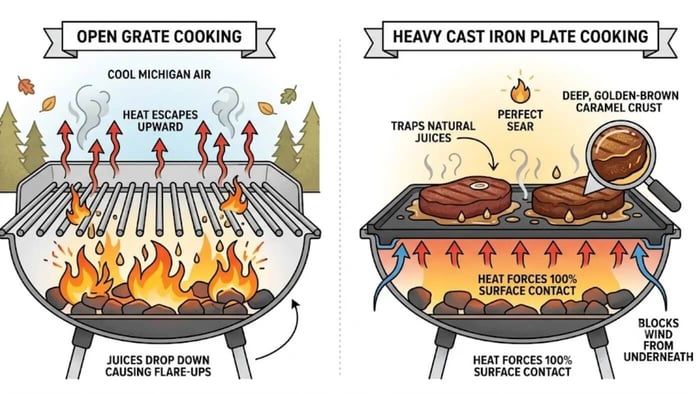
The Problem: Standard grill grates are a nightmare for local delicacies like fresh whitefish or lake trout; the skin sticks to the grates, the flesh tears apart, and valuable juices drop directly into the flame tamers, causing aggressive flare-ups that ruin the flavor profile.
The Solution: The smooth face of the heavy iron plate traps the rendering fats and natural oils directly beneath the protein. When searing fish or pressing smash burgers with a heavy iron press, the continuous contact forces a uniform crust. The food lifts away cleanly from the naturally seasoned surface without tearing, retaining 100% of its moisture and locking in the smoky aromas of local cherry-wood chips placed in the smoker box.
Side B Case Study Analysis (The Engineered Radiant Ridge)
When dinner required transitioning from flat-top griddling to heavy steakhouse proteins, the operator simply used heat-resistant gloves to flip the hot plate over, exposing the deep-grooved ridge side.
▲ ▲ ▲  [Elevated Sharp Ridges]  ---> Direct Conductive Sear Lines
│ │ │  [Deep Channel Vaults]   ---> Drops Excess Rendering Safe From Flare-Ups
Traditional open flames often char the exterior of a thick cut of meat unevenly because local wind shifts constantly disrupt the gas fire underneath. The raised ridges of this heavy-gauge asset act as direct conductive rails. The meat rests only on the apex of the iron teeth, receiving an intense, dark sear mark instantly, while the deep valleys between the ridges allow radiative heat to cook the interior of the cut to a perfect medium-rare without burning the outer tissue.
Northern Michigan Climate & Maintenance Realities
Living near the water in the 49684 region means dealing with high humidity in the summer and freezing damp air in the shoulder seasons. An outdoor asset of this caliber requires proper operational maintenance to ensure lifelong durability against rust.
Unlike mass-market non-stick cookware finished with toxic chemical coatings that flake under high temperatures, an authentic two-sided cast iron griddle utilizes a completely natural, polymerized oil seasoning coating that improves with age.
The Upstate Architectural Seasoning Protocol:
The Cleanse: After a cooking session, scrape the surface clean with a flat iron spatula while the unit is still warm. Avoid harsh detergents, dish soaps, or steel wire brushes that strip the iron's profile.
The Moisture Barrier: Wipe down the entire surface with a thin layer of high-smoke-point oil (avocado or refined flaxseed oil) to protect the metal from the humid lakeside air.
The Thermal Bake: Heat the oiled iron until it reaches its smoke point, bonding the oil molecules directly into the microscopic pores of the iron, creating an indestructible, rust-resistant hydrophobic barrier that survives the dampest Upstate seasons.
Direct Structural Alignment: Final Architectural Review
True luxury in outdoor design is realized when form meets flawless versatility. By introducing a heavy, artisan-crafted two-sided cast iron griddle to your outdoor kitchen array, you effectively remove the limits of open-air gastronomy. You no longer have to choose between a dedicated flat-top griddle and a traditional open-flame grill—you own the absolute pinnacle of both worlds within a single, highly refined heirloom asset built to conquer the elements.
FAQs
What is the primary benefit of a reversible griddle over a standalone unit?
The primary benefit of a reversible two-sided cast iron griddle is spatial and financial efficiency. It allows a homeowner to seamlessly toggle between a flat-top outdoor diner station and a high-profile steakhouse grill grate within the exact same structural footprint, eliminating the need to buy, plumb, and maintain two separate heavy appliances on a space-limited patio or covered porch.
Can you use a heavy cast iron griddle on a luxury built-in gas grill?
Yes, provided the griddle possesses an engineered perimeter lip and sufficient mass to distribute the intense heat evenly. A commercial-grade two-sided cast iron griddle is designed to sit safely directly on top of high-output luxury burners, absorbing raw energy and transforming unstable gas flames into smooth, predictable radiant warmth that resists wind interference.